Cassette Air Conditioning Adelaide


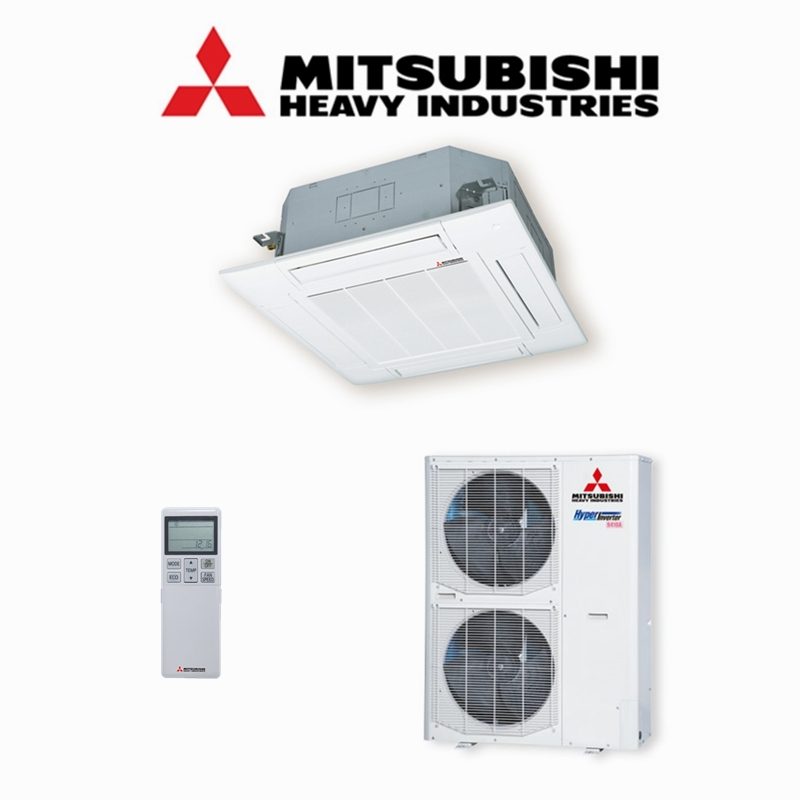
Deadshort Services provides installation, repairs and servicing for cassette air conditioning Adelaide homes, offices, retail properties and suitable commercial sites. A cassette air conditioner positions the indoor unit within a suitable ceiling space, leaving a visible fascia or grille that distributes heated or cooled air into the room.
Our experienced air conditioning team can assist with new cassette air conditioner installation, replacement of ageing systems, fault finding, cassette air conditioning repairs and ongoing servicing. We work with established air conditioning brands and assess the complete system, including the indoor cassette unit, outdoor equipment, controls, refrigerant pipework, condensate drainage, drain pump where fitted and electrical requirements.
For broader support, visit our air conditioning Adelaide page. We also provide air conditioning installation Adelaide and air conditioning service and repair Adelaide for a wide range of residential and commercial systems.
Cassette air conditioning Adelaide can suit properties where a ceiling-mounted indoor unit provides a better option than a conventional wall split system. Instead of mounting the indoor unit high on a wall, the main cassette body is installed within or above a suitable ceiling space, with the fascia visible from below.
Depending on the manufacturer, model and cassette design, conditioned air may be distributed in one direction, four directions or across a broader multi-directional pattern. This can make cassette air conditioning suitable for open-plan rooms, offices, retail spaces, consulting rooms, larger living areas and other sites where broad airflow distribution is required.
Deadshort Services assists with cassette air conditioner installation Adelaide, existing cassette system repairs, replacement options, servicing and fault diagnosis. We assess how the room is actually used rather than assuming every property requires the same cassette position, capacity or airflow arrangement.
Cassette air conditioning can suit:
Open-plan offices
Retail stores
Consulting rooms
Meeting rooms
Restaurants and cafés
Reception areas
Larger living rooms
Suitable apartments
Commercial tenancies
Showrooms
The right system depends on room loads, ceiling height, available ceiling space, building construction, window area, sun exposure, cassette position, indoor unit capacity, outdoor unit capacity, condensate drainage and how the room is likely to be used.
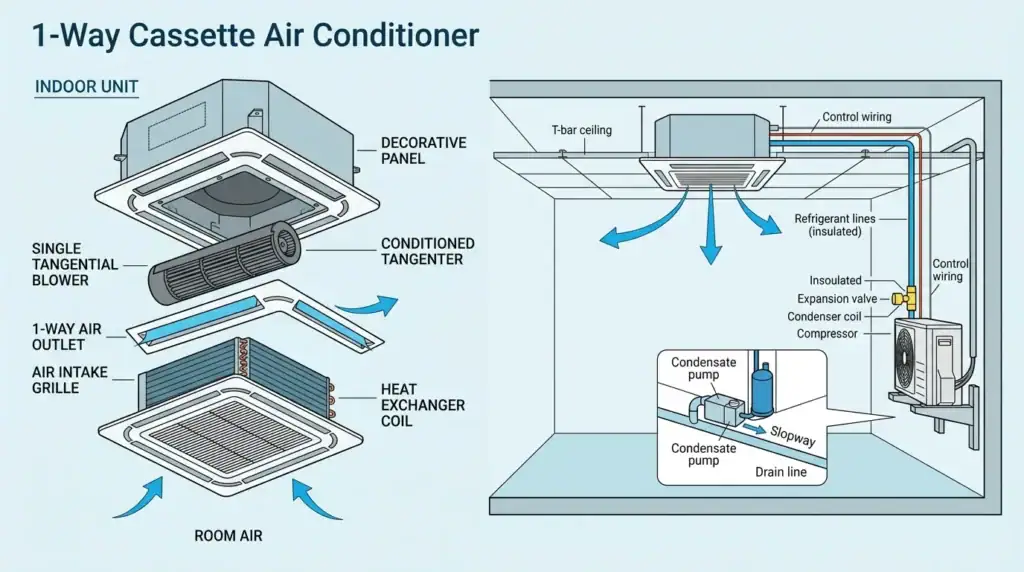
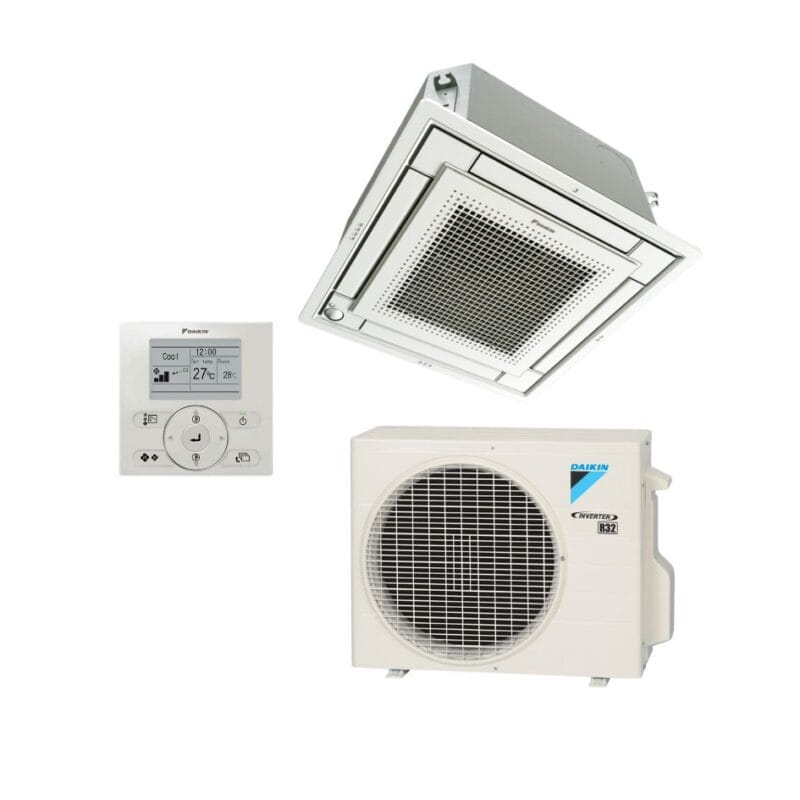
A cassette air conditioning system draws room air into the indoor cassette unit, heats or cools that air and then distributes it back into the occupied space through the cassette outlets.
A typical cassette air conditioning system includes:
Indoor ceiling cassette unit
Visible fascia or grille
Outdoor unit
Refrigerant pipework
Communication wiring
Electrical supply
Condensate drainage
Drain pump where fitted
Controller or remote
Sensors and electronic controls
The indoor cassette and outdoor equipment work together as one air conditioning system.
During cooling operation, moisture removed from the indoor air creates condensate that must be drained away correctly. Because cassette units are installed in or above the ceiling, condensate drainage and drain pump operation where fitted are important parts of system design, servicing and fault diagnosis.
It is also important to understand that a cassette air conditioner requires suitable ceiling space, practical access and correctly planned pipework, drainage and electrical connections. A position that looks suitable from inside the room may not be practical once the space above the ceiling is assessed.
Selecting a cassette air conditioner involves more than choosing a unit based on floor area.
Deadshort Services considers the complete installation, including:
Room size
Ceiling height
Available ceiling space
Ceiling construction
Insulation
Window size
Window orientation
Afternoon sun exposure
Building materials
Room usage
Number of occupants
Internal heat loads
Cassette position
Indoor unit capacity
Outdoor unit capacity
Outdoor unit position
Refrigerant pipe routes
Condensate drainage
Drain pump requirements where applicable
Electrical supply
Service access
Airflow pattern
A retail store with large windows, regular customer traffic and substantial lighting loads may require a very different cassette system from a quiet office with the same floor area.
Correct system selection is particularly important with cassette air conditioning because ceiling space, drainage, airflow direction and service access all need to be considered before installation.
Cassette air conditioning is not the best option for every property.
Important considerations include:
Ceiling Space Requirements
Cassette air conditioners require suitable space above the visible ceiling level, and some properties may not have enough depth or clearance for the indoor unit.
More Complex Installation Than a Basic Wall Split
Cassette systems require more careful planning because ceiling access, indoor unit support, pipework, drainage, electrical connections and future servicing all need to be considered.
Condensate Drainage Requirements
Cooling operation creates condensate that must be removed correctly, making drainage design and drain pump operation where fitted important parts of the installation.
Access Requirements
Suitable access is needed for installation, servicing and future repairs to the cassette unit, filters, drain components, pipework and electrical controls.
Ceiling Layout Restrictions
Lighting, structural framing, fire services, plumbing, electrical wiring, ductwork and other services can limit where a cassette unit can be installed.
Airflow Positioning
Poor cassette placement can create drafts over occupied areas or uneven air distribution across the room.
Future Replacement Considerations
Replacing an ageing cassette system can be more involved if the dimensions of the existing ceiling opening, indoor unit, fascia or pipework do not suit newer equipment.
Not Suitable for Every Room
Small bedrooms, rooms with limited ceiling space or properties with difficult access may be better suited to another type of air conditioning system.
A major practical consideration is ceiling access.
A wall split system can often be installed without requiring the same type of ceiling cavity. With a cassette system, the building must physically support the indoor unit and allow access for installation, drainage, servicing and future repairs.
This does not make cassette air conditioning a poor choice. It simply means the advantages and limitations should be understood before installation.
Deadshort Services believes system selection should be based on the property and intended use rather than forcing every customer toward the same type of air conditioner.
Broad Airflow Distribution
One of the main reasons property owners consider cassette air conditioning is the ability to distribute conditioned air across a wider section of the room. Depending on the cassette design, airflow may be directed through multiple outlets rather than from one wall-mounted position.
Keeps Wall Space Clear
A cassette air conditioner can leave wall areas available for windows, shelving, displays, furniture, artwork or other building features. This can be particularly useful in offices, retail stores and commercial spaces.
Discreet Ceiling-Integrated Appearance
The main indoor cassette body sits within or above the ceiling, with the visible fascia or grille remaining in the room. This can provide a cleaner appearance than a conventional wall-mounted indoor unit in some properties.
Suitable for Open-Plan Areas
Cassette air conditioning can suit larger open rooms where a broader airflow pattern is required. Applications may include offices, retail spaces, meeting rooms, showrooms and larger living areas.
Multiple Airflow Options
Depending on the manufacturer and model, cassette systems may be available with one-way, four-way or other multi-directional airflow arrangements. The correct option depends on room shape, intended use and available ceiling space.
Residential and Commercial Applications
Cassette air conditioning is commonly used in commercial properties but can also suit selected residential applications where the building provides suitable ceiling space and access.
Deadshort Services also offers the benefit of a multi-trade service team, allowing customers to access several qualified trades through one trusted company. This makes it easier to coordinate projects that involve multiple trades and ensures work is completed efficiently.
Alongside ducted air conditioning services, our in-house team can assist with:
Electrical services and switchboard upgrades
Plumbing and gas fitting
This multi-trade capability allows Deadshort Services to support both residential and commercial clients with a wide range of building and maintenance services, all coordinated through one experienced team.
Whether you are installing a new ducted system or maintaining an existing one, our technicians deliver reliable air conditioning solutions designed for long-term performance.
In addition to Wall Split Systems, Deadshort Services also services and maintains a wide range of air conditioning equipment used across Adelaide hoes and businesses.
Our technicians regularly assist with:
Evaporative Air Conditioning Systems
Commercial Air Conditioning Systems
Service and maintenance programs
Because our technicians work across multiple air conditioner types and designs, they can often identify ways to improve the system performance.
A cassette air conditioner has an indoor unit installed within or above a suitable ceiling space, with a visible fascia or grille distributing conditioned air into the room.
No. Cassette systems are common in offices, shops and other commercial properties but can also suit selected homes and apartments where suitable ceiling space, drainage and service access are available.
The required ceiling space depends on the manufacturer, cassette model, indoor unit dimensions, pipework, drainage and access requirements. The proposed ceiling area should be assessed before installation.
A wall split system mounts the indoor unit on a wall, while a cassette air conditioner positions the main indoor unit within or above the ceiling. Cassette systems may also distribute air across multiple directions depending on the design.
A cassette air conditioner generally delivers conditioned air directly from the ceiling-mounted cassette unit. Ducted air conditioning usually distributes air through concealed ductwork and separate ceiling or wall outlets.
Many reverse cycle cassette systems can provide both heating and cooling. The available operation depends on the specific system installed.
A 4-way cassette air conditioner distributes conditioned air through multiple sides of the ceiling fascia. This can suit open rooms where broader airflow distribution is required.
A 1-way cassette directs conditioned air primarily in one direction and may suit selected room shapes or installation positions where a multi-directional cassette is not appropriate.
Possible causes include a blocked condensate drain, drain pump fault where fitted, restricted drainage, dirty filters, coil icing or an installation issue. Water leaking from a ceiling cassette should be investigated promptly.
Possible causes include dirty filters, restricted airflow, dirty coils, refrigerant issues, sensor faults, fan problems, controller faults, outdoor unit faults or system capacity problems. Proper diagnosis is required.
Weak airflow may be caused by dirty filters, fan problems, blocked airflow paths, dirty coils, incorrect settings or faults within the indoor unit.
The cause may relate to outlet settings, louvre control, airflow configuration, internal faults or the design of the specific cassette system. The installed model should be checked.
Many cassette systems use built-in or associated condensate drain pumps, but the exact arrangement depends on the manufacturer and model. Drainage should be assessed according to the installed system.
Service frequency depends on system use, occupancy, environment and equipment condition. Commercial systems operating for long periods may require more frequent attention than lightly used residential systems.
Yes, but replacement may require assessment of the existing ceiling opening, indoor unit dimensions, fascia size, refrigerant pipework, drainage, electrical supply and compatibility with new equipment.
Yes. Deadshort Services provides air conditioning fault diagnosis and repair support for suitable existing cassette systems. The repair path depends on the brand, model, age, fault, parts availability and overall condition of the system.
Click on the suburb areas below for our full installation and maintenance coverage – “One number one Call multiple trades”