



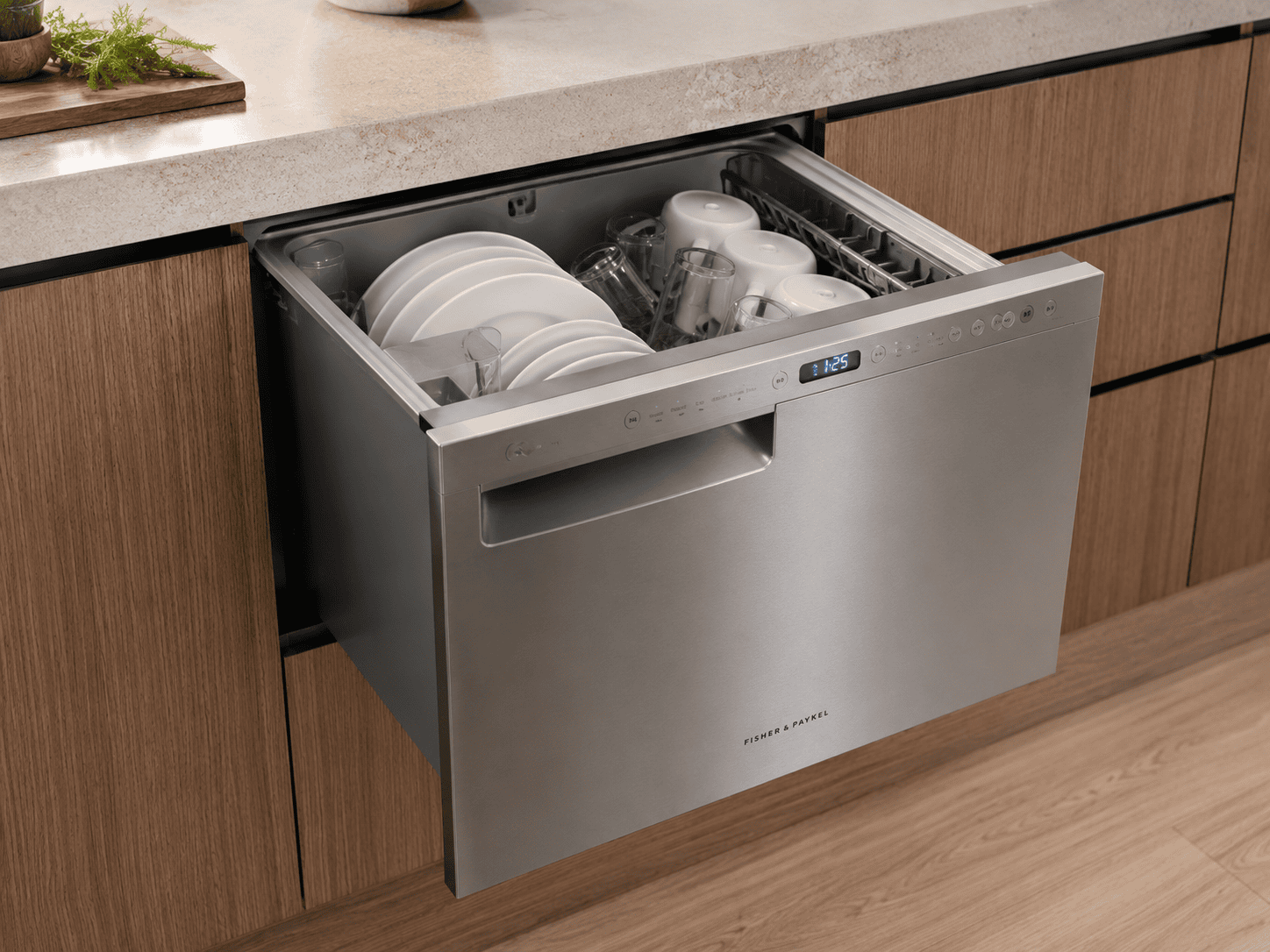
Fisher & Paykel DishDrawer Fault Codes
Fisher & Paykel DishDrawer fault codes can appear as F codes, A codes, E codes, U codes, beeping patterns or flashing lights, depending on the model. This guide explains common Fisher & Paykel DishDrawer error codes for single DishDrawer, double DishDrawer, integrated DishDrawer and classic DishDrawer models, including F1, F2, A1, A3, A6, A7, A09, E1 and U1 faults.
Below, we explain what these DishDrawer fault codes usually mean, what safe checks homeowners can do, and when Fisher & Paykel DishDrawer repairs should be handled by a technician.
Because DishDrawer dishwashers use both water and electricity, safe checks should stay basic. You can check the displayed code, look for visible leaks, check whether the tap is on, inspect the drain hose, clean the filter and check the spray arm. However, internal testing, flood switch diagnosis, heating faults, motor faults and electronic faults should be handled by a qualified appliance repair technician.
Deadshort Services can assist with dishwasher repairs Adelaide customers may need when a Fisher & Paykel DishDrawer has stopped draining, started beeping, shown a fault code or developed a leak. We can also assist with broader appliance repairs Adelaide, home appliance repairs Adelaide and kitchen appliance repairs Adelaide.
Fisher & Paykel DishDrawer Error Codes Explained
Fisher & Paykel DishDrawer error codes are usually shown as a letter and number. Common examples include A1, A3, A6, A7, A09, F1, F2, F3, F4, F5, F6, F7, F8, F9, U1, U4, U6, E1, E2, E3 and EC.
Some models show the code on a display. Other DishDrawer models show flashing lights, beeping patterns or wash-program indicators. Therefore, the same fault may appear differently depending on the exact model.
For example, one Fisher & Paykel DishDrawer may show A3 for a drain fault. Another model may use flashing lights to show the same issue. In addition, older classic DishDrawer models may use U codes, while integrated DishDrawer models may use E codes.
Before You Check a Fisher & Paykel DishDrawer Fault Code
Before checking any Fisher & Paykel DishDrawer fault code, write down the code shown on the display. If there is no display, take note of the beeping pattern, flashing lights and which wash-program indicators are lit.
If water is leaking, turn the appliance off if it is safe to do so. Also turn off the water supply. Do not keep resetting a DishDrawer that is leaking, tripping power, smelling burnt or repeatedly showing the same fault.
Basic checks are fine. However, do not open electrical covers, test control boards, bypass sensors or pull apart wiring. Fisher & Paykel DishDrawer repairs often involve water, power, pumps, heaters, motors and electronic controls. Therefore, repeated faults should be inspected by a technician.
Fisher & Paykel DishDrawer Model Types Covered
This guide covers common Fisher & Paykel DishDrawer fault codes across several domestic model types, including single DishDrawer dishwashers, double DishDrawer dishwashers, integrated DishDrawer models, designer integrated DishDrawer models and older classic DishDrawer models.
That matters because Fisher & Paykel DishDrawer error codes can appear differently depending on the model. Some appliances show F codes, while others may show A codes, E codes, U codes, beeping patterns or flashing lights.
If your DishDrawer does not show the exact code listed below, check the model number and record the display, beeping pattern or flashing indicators before booking a repair.



Fisher & Paykel DishDrawer Fault Codes Table
The table below gives a practical overview of common Fisher & Paykel DishDrawer fault codes. Always check the model number and user manual, because code meanings can vary between classic, designer, integrated, single drawer and double drawer models.
| Code | Applies To | Likely Meaning | Safe Check | Repair Path |
|---|---|---|---|---|
| A1 / U1 | DishDrawer | No water | Check tap and hose | Inlet diagnosis |
| A3 | DishDrawer | Cannot drain | Check filter and drain hose | Pump or drain repair |
| A6 / U6 | DishDrawer | Spray arm fault | Check spray arm | Water pressure check |
| A7 | DishDrawer | Foam recovery | Use correct detergent | Foam or leak check |
| A09 | DishDrawer | Sanitize temperature | Run cycle again | Heating diagnosis |
| F1 / E1 | DishDrawer | Flood or foam | Check for water | Leak diagnosis |
| F2 / E2 | DishDrawer | Motor rotor fault | Check for debris | Rotor or motor repair |
| F3 / E3 | DishDrawer | Temperature fault | Check water supply | Sensor diagnosis |
| F4 / E4 | DishDrawer | Heating fault | No DIY repair | Heater repair |
| F5 / E5 | DishDrawer | Lid motor fault | Check tall items | Lid motor repair |
| F6 / E6 | DishDrawer | Drying fan fault | No DIY repair | Fan diagnosis |
| F7 / E7 | DishDrawer | Fill valve fault | Check water tap | Valve repair |
| F8 / E8 | DishDrawer | Electronics fault | Power reset only | Control repair |
| F9 / E9 | DishDrawer | Wash controller fault | Power reset only | Controller repair |
| FC / EC | Double DishDrawer | Drawer communication | Power reset only | Wiring or board repair |
| U2 | Older DishDrawer | Lid cannot seal | Remove tall items | Lid mechanism check |
| U4 | Double DishDrawer | Other drawer fault | Check second drawer | Drawer diagnosis |
Fisher & Paykel DishDrawer F1 Fault
A Fisher & Paykel DishDrawer F1 fault commonly points to a flood condition or excess foaming. On some models, this may also appear as E1. This is one of the most important Fisher & Paykel DishDrawer fault codes because it can involve water in the base of the appliance.
If water is visible on the floor or around the DishDrawer, stop using the appliance. Then turn off the water supply and isolate power if it is safe to do so. Do not keep resetting a leaking DishDrawer. A repeated F1 fault can point to a leak, failed seal, hose fault, drain fault, inlet problem, overfilling issue or flood switch activation.
If there is no visible water, the F1 fault may be linked to excessive foam. This can happen when too much detergent is used or when the wrong detergent is placed in the drawer. However, because foam and leaks can both trigger flood protection, the fault still needs to be treated carefully.
Possible repair paths include checking for water in the base pan, inspecting the drawer seals, checking hoses, testing the inlet valve, inspecting the drain path and confirming whether the flood switch has activated. These checks are best handled by a technician.
Fisher & Paykel DishDrawer F2 Fault
A Fisher & Paykel DishDrawer F2 fault usually relates to a motor rotor issue. On some integrated or designer models, the same general fault may appear as E2.
The motor rotor can be affected by food debris, small fragments, glass, jamming, wear or a failed motor component. In some cases, the drawer may stop washing properly, make unusual noises, fail to circulate water or stop shortly after starting.
A basic safe check is to stop the appliance and check for visible debris inside the drawer. However, rotor removal and motor diagnosis should only be attempted where the model manual specifically allows it and the appliance has been isolated correctly. If the fault returns, the rotor, pump motor or related sensor may need repair or replacement.
Fisher & Paykel DishDrawer A1 or U1 Fault
A Fisher & Paykel DishDrawer A1 fault or U1 fault usually relates to water supply. The DishDrawer may not be filling correctly, or the appliance may not detect enough incoming water.
Common causes include a water tap that is turned off, low water pressure, a kinked inlet hose, a blocked tap filter, a failed inlet valve or a control issue.
Safe checks include confirming the tap is on, checking the inlet hose for bends and making sure there is household water pressure. If the code returns after these checks, the DishDrawer may need inlet valve testing or electronic diagnosis.
Fisher & Paykel DishDrawer A3 Fault
A Fisher & Paykel DishDrawer A3 fault means the drawer cannot drain. This is one of the most common Fisher & Paykel DishDrawer error codes because drainage issues are common in domestic dishwashers.
Common causes include a blocked filter, kinked drain hose, blocked sink spigot, blocked waste connection, drain pump fault or debris caught in the drain path.
Safe checks include cleaning the filter, checking whether the drain hose is kinked and checking whether the sink waste connection is blocked. However, if water remains in the drawer or the fault returns, a technician should inspect the drain pump, hose route and waste connection.
Fisher & Paykel DishDrawer A6 or U6 Fault
A Fisher & Paykel DishDrawer A6 or U6 fault usually relates to the spray arm or water pressure. The spray arm may not be fitted properly, may have come loose or may not be rotating correctly.
Start by checking that the spray arm is clipped in place and can turn freely. Also check for obvious food scraps or small items blocking spray-arm movement. If the spray arm is clear and correctly fitted, low water pressure or a water-fill issue may be involved.
If the fault continues, the repair path may include checking water pressure, inlet flow, spray-arm parts and internal wash performance.
Fisher & Paykel DishDrawer A7 Fault
A Fisher & Paykel DishDrawer A7 fault usually relates to the auto-recovery program. This is often connected to foam inside the drawer.
Foaming can happen when the wrong detergent is used, too much detergent is added or rinse aid is spilled. Let the recovery program complete if the appliance is running safely and there is no visible leak. After that, use the correct automatic dishwasher detergent and reduce the amount used.
If the drawer remains full of foam or the fault returns, the appliance should be checked. Repeated foam faults can also hide drainage or leak issues.
Fisher & Paykel DishDrawer A09 Fault
A Fisher & Paykel DishDrawer A09 fault usually means the sanitize cycle did not reach the required temperature. This may happen if the water supply was interrupted, the incoming water was not hot enough or the appliance has a heating-related fault.
Try running the sanitize cycle again if there are no leaks or electrical issues. However, if the fault returns, the DishDrawer may need a technician to inspect the heater, temperature sensor or control board.
Fisher & Paykel Integrated DishDrawer E Codes
Some Fisher & Paykel integrated DishDrawer models use E codes instead of F codes. This is common on designer or integrated models where the fault may be shown through a badge, remote display or flashing indicators.
In many cases, E codes mirror the same type of fault as F codes. For example, E1 can relate to flooding, E2 can relate to a motor rotor fault, E3 can relate to a temperature sensor fault and E4 can relate to a heating fault.
Because integrated DishDrawer models can be harder to access, repeated E codes should be handled carefully. Do not remove cabinetry panels, open wiring compartments or keep running the appliance if there is water present.
Fisher & Paykel Double DishDrawer Fault Codes
Double DishDrawer models can show faults in one drawer that affect the other drawer. For example, U4 can indicate a fault in the other drawer. FC or EC codes can also point to communication issues between drawers.
If one drawer is working and the other is not, record which drawer shows the fault. Also note whether the fault occurs on the top drawer, bottom drawer or both drawers.
Double DishDrawer repair paths may include checking the individual drawer, lid motor, motor rotor, drain path, flood switch, wiring harness and control boards. Because drawer-to-drawer communication faults can involve electronics, technician diagnosis is usually required.
Fisher & Paykel DishDrawer Beeping and Flashing Lights
A Fisher & Paykel DishDrawer may beep, flash lights or show wash-program indicators when a fault occurs. This is common on models without a full digital display.
Before booking a repair, write down the pattern. Note which lights are flashing, whether the lock indicator is active and whether the fault appears on the top drawer, bottom drawer or both.
Beeping can point to water supply, drainage, spray-arm, flooding, motor, lid or electronic faults. However, the exact meaning depends on the model. Therefore, a fault-code table should always be checked against the appliance model number.
Can You Reset a Fisher & Paykel DishDrawer Fault Code?
Some Fisher & Paykel DishDrawer fault codes may clear after a power reset. This can help if the fault was temporary. However, a reset is not a repair.
Do not keep resetting a DishDrawer if the code returns. Also, do not reset and continue using the appliance if there is water on the floor, a burning smell, tripping power, unusual motor noise or repeated beeping.
If the same Fisher & Paykel DishDrawer fault code returns after reset, the appliance needs proper diagnosis. Repeated faults usually mean there is an underlying issue.
When to Call a Technician for Fisher & Paykel DishDrawer Fault Codes
You should call a technician if the DishDrawer shows a repeated fault code, will not drain, keeps beeping, leaks water, trips power, does not heat, will not start or shows an electronic fault.
Technician diagnosis is also recommended for F1, F2, F3, F4, F5, F6, F7, F8, F9, FC, EC and repeated E-code faults. These faults can involve flood switches, motors, heaters, sensors, wiring, control boards or drawer mechanisms.
Deadshort Services can help with Fisher & Paykel DishDrawer repairs Adelaide customers may need when the appliance fault involves water, drainage, power, controls, installation or safety. Where a plumbing or electrical issue is involved, our wider team can also support the repair pathway through plumbing Adelaide and electrical repairs Adelaide.
Why Choose Deadshort Services for Fisher & Paykel DishDrawer Repairs?
Deadshort Services is a South Australian owned multi-trade company with more than 35 years of experience across appliance repairs Adelaide, electrical repairs Adelaide, plumbing Adelaide, gas, air conditioning, roofing, fencing and home services.
For Fisher & Paykel DishDrawer repairs Adelaide customers, this matters because many dishwasher faults are not just appliance faults. A DishDrawer problem may involve drainage, water supply, power, isolation, cabinetry access, installation issues or control faults.
Deadshort Services can support Fisher & Paykel DishDrawer fault-code diagnosis, dishwasher repairs Adelaide, home appliance repairs Adelaide and kitchen appliance repairs Adelaide. In addition, our licensed plumbing and electrical teams can assist when the repair pathway involves water supply, drainage, power or safety.
Key reasons to choose Deadshort Services include:
- South Australian owned
- 35+ years’ experience
- Dishwasher repairs Adelaide support
- Fisher & Paykel DishDrawer repairs Adelaide support
- Appliance repairs Adelaide support
- Licensed electrical repairs Adelaide and plumbing Adelaide support
- Same-day service where available
- Police-cleared technicians
- Working With Children checked trades where required
- Upfront pricing and clear repair advice
- One company, one scheduler and multi-trade support

Fisher & Paykel DishDrawer Fault Code FAQs
Q – What does F1 mean on a Fisher & Paykel DishDrawer?
F1 commonly indicates a flood fault or excess foam. If water is visible, stop using the appliance, turn off the water and arrange technician diagnosis.
Q – Why is my Fisher & Paykel DishDrawer beeping?
Beeping usually means the DishDrawer has detected a fault. The cause may involve water supply, drainage, spray arm movement, flooding, heating, motor operation or electronics.
Q – What does A3 mean on a Fisher & Paykel DishDrawer?
A3 usually means the drawer cannot drain. Check the filter and drain hose. If water still remains, the drain pump or waste connection may need service.
Q – What does A1 mean on a Fisher & Paykel DishDrawer?
A1 usually means a water supply fault. Check that the tap is on and the inlet hose is not kinked. If the fault returns, the inlet valve may need diagnosis.
Q – What does F2 mean on a Fisher & Paykel DishDrawer?
F2 usually relates to a motor rotor fault. Debris, wear or a failed rotor can cause the fault. If it returns, a technician should inspect the motor area.
Q – Are Fisher & Paykel DishDrawer fault codes different from normal dishwashers?
Yes. DishDrawer models use different codes from many freestanding or built-in Fisher & Paykel dishwashers. Model number matters.
Q – Do integrated Fisher & Paykel DishDrawer models use the same codes?
Some integrated DishDrawer models use E codes or indicator patterns instead of standard F codes. The fault meaning can still be similar, but the display style may differ.
Q – Can I repair a Fisher & Paykel DishDrawer fault myself?
You can do basic checks such as checking the tap, hose, filter and spray arm. However, electrical, heating, motor, flood switch and control faults should be handled by a technician.
Q – Should I keep resetting my Fisher & Paykel DishDrawer?
No. A single reset may clear a temporary fault. However, repeated faults need diagnosis. Do not keep resetting a leaking, tripping or overheating appliance.
Q – Does Deadshort Services repair Fisher & Paykel DishDrawer dishwashers in Adelaide?
Yes, Deadshort Services can assist with out-of-warranty Fisher & Paykel DishDrawer repairs Adelaide customers may need. We do not claim to be an authorised Fisher & Paykel warranty agent unless specifically stated.
Book Fisher & Paykel DishDrawer Repairs in Adelaide
If your Fisher & Paykel DishDrawer is showing a fault code, beeping, flashing lights, leaking, not draining, not heating or not starting, Deadshort Services can help with practical appliance repair support.
Our team can assist with dishwasher repairs Adelaide, appliance repairs Adelaide, home appliance repairs Adelaide and kitchen appliance repairs Adelaide.
Because DishDrawer faults can involve water, power, drainage and installation issues, Deadshort Services also has licensed plumbing and electrical support available where required. That means one team can help identify whether the issue sits with the appliance, power supply, water supply, drainage connection or installation.
Call Deadshort Services to book Fisher & Paykel DishDrawer repairs in Adelaide.
- Fisher & Paykel DishDrawer Fault Codes Guide
-
BOOK ONLINE(08) 8410 0887(08) 8410 0887BOOK ONLINE
Fisher & Paykel DishDrawer Fault Codes
Fisher & Paykel DishDrawer fault codes can appear as F codes, A codes, E codes, U codes, beeping patterns or flashing lights, depending on the model. This guide explains common Fisher & Paykel DishDrawer error codes for single DishDrawer, double DishDrawer, integrated DishDrawer and classic DishDrawer models, including F1, F2, A1, A3, A6, A7, A09, E1 and U1 faults.
Below, we explain what these DishDrawer fault codes usually mean, what safe checks homeowners can do, and when Fisher & Paykel DishDrawer repairs should be handled by a technician.
Because DishDrawer dishwashers use both water and electricity, safe checks should stay basic. You can check the displayed code, look for visible leaks, check whether the tap is on, inspect the drain hose, clean the filter and check the spray arm. However, internal testing, flood switch diagnosis, heating faults, motor faults and electronic faults should be handled by a qualified appliance repair technician.
Deadshort Services can assist with dishwasher repairs Adelaide customers may need when a Fisher & Paykel DishDrawer has stopped draining, started beeping, shown a fault code or developed a leak. We can also assist with broader appliance repairs Adelaide, home appliance repairs Adelaide and kitchen appliance repairs Adelaide.
Fisher & Paykel DishDrawer Error Codes Explained
Fisher & Paykel DishDrawer error codes are usually shown as a letter and number. Common examples include A1, A3, A6, A7, A09, F1, F2, F3, F4, F5, F6, F7, F8, F9, U1, U4, U6, E1, E2, E3 and EC.
Some models show the code on a display. Other DishDrawer models show flashing lights, beeping patterns or wash-program indicators. Therefore, the same fault may appear differently depending on the exact model.
For example, one Fisher & Paykel DishDrawer may show A3 for a drain fault. Another model may use flashing lights to show the same issue. In addition, older classic DishDrawer models may use U codes, while integrated DishDrawer models may use E codes.
Before You Check a Fisher & Paykel DishDrawer Fault Code
Before checking any Fisher & Paykel DishDrawer fault code, write down the code shown on the display. If there is no display, take note of the beeping pattern, flashing lights and which wash-program indicators are lit.
If water is leaking, turn the appliance off if it is safe to do so. Also turn off the water supply. Do not keep resetting a DishDrawer that is leaking, tripping power, smelling burnt or repeatedly showing the same fault.
Basic checks are fine. However, do not open electrical covers, test control boards, bypass sensors or pull apart wiring. Fisher & Paykel DishDrawer repairs often involve water, power, pumps, heaters, motors and electronic controls. Therefore, repeated faults should be inspected by a technician.
Fisher & Paykel DishDrawer Model Types Covered
This guide covers common Fisher & Paykel DishDrawer fault codes across several domestic model types, including single DishDrawer dishwashers, double DishDrawer dishwashers, integrated DishDrawer models, designer integrated DishDrawer models and older classic DishDrawer models.
That matters because Fisher & Paykel DishDrawer error codes can appear differently depending on the model. Some appliances show F codes, while others may show A codes, E codes, U codes, beeping patterns or flashing lights.
If your DishDrawer does not show the exact code listed below, check the model number and record the display, beeping pattern or flashing indicators before booking a repair.
Fisher & Paykel DishDrawer Fault Codes Table
The table below gives a practical overview of common Fisher & Paykel DishDrawer fault codes. Always check the model number and user manual, because code meanings can vary between classic, designer, integrated, single drawer and double drawer models.
Code Applies To Likely Meaning Safe Check Repair Path A1 / U1 DishDrawer No water Check tap and hose Inlet diagnosis A3 DishDrawer Cannot drain Check filter and drain hose Pump or drain repair A6 / U6 DishDrawer Spray arm fault Check spray arm Water pressure check A7 DishDrawer Foam recovery Use correct detergent Foam or leak check A09 DishDrawer Sanitize temperature Run cycle again Heating diagnosis F1 / E1 DishDrawer Flood or foam Check for water Leak diagnosis F2 / E2 DishDrawer Motor rotor fault Check for debris Rotor or motor repair F3 / E3 DishDrawer Temperature fault Check water supply Sensor diagnosis F4 / E4 DishDrawer Heating fault No DIY repair Heater repair F5 / E5 DishDrawer Lid motor fault Check tall items Lid motor repair F6 / E6 DishDrawer Drying fan fault No DIY repair Fan diagnosis F7 / E7 DishDrawer Fill valve fault Check water tap Valve repair F8 / E8 DishDrawer Electronics fault Power reset only Control repair F9 / E9 DishDrawer Wash controller fault Power reset only Controller repair FC / EC Double DishDrawer Drawer communication Power reset only Wiring or board repair U2 Older DishDrawer Lid cannot seal Remove tall items Lid mechanism check U4 Double DishDrawer Other drawer fault Check second drawer Drawer diagnosis BOOK ONLINE(08) 8410 0887Fisher & Paykel DishDrawer F1 Fault
A Fisher & Paykel DishDrawer F1 fault commonly points to a flood condition or excess foaming. On some models, this may also appear as E1. This is one of the most important Fisher & Paykel DishDrawer fault codes because it can involve water in the base of the appliance.
If water is visible on the floor or around the DishDrawer, stop using the appliance. Then turn off the water supply and isolate power if it is safe to do so. Do not keep resetting a leaking DishDrawer. A repeated F1 fault can point to a leak, failed seal, hose fault, drain fault, inlet problem, overfilling issue or flood switch activation.
If there is no visible water, the F1 fault may be linked to excessive foam. This can happen when too much detergent is used or when the wrong detergent is placed in the drawer. However, because foam and leaks can both trigger flood protection, the fault still needs to be treated carefully.
Possible repair paths include checking for water in the base pan, inspecting the drawer seals, checking hoses, testing the inlet valve, inspecting the drain path and confirming whether the flood switch has activated. These checks are best handled by a technician.
Fisher & Paykel DishDrawer F2 Fault
A Fisher & Paykel DishDrawer F2 fault usually relates to a motor rotor issue. On some integrated or designer models, the same general fault may appear as E2.
The motor rotor can be affected by food debris, small fragments, glass, jamming, wear or a failed motor component. In some cases, the drawer may stop washing properly, make unusual noises, fail to circulate water or stop shortly after starting.
A basic safe check is to stop the appliance and check for visible debris inside the drawer. However, rotor removal and motor diagnosis should only be attempted where the model manual specifically allows it and the appliance has been isolated correctly. If the fault returns, the rotor, pump motor or related sensor may need repair or replacement.
Fisher & Paykel DishDrawer A1 or U1 Fault
A Fisher & Paykel DishDrawer A1 fault or U1 fault usually relates to water supply. The DishDrawer may not be filling correctly, or the appliance may not detect enough incoming water.
Common causes include a water tap that is turned off, low water pressure, a kinked inlet hose, a blocked tap filter, a failed inlet valve or a control issue.
Safe checks include confirming the tap is on, checking the inlet hose for bends and making sure there is household water pressure. If the code returns after these checks, the DishDrawer may need inlet valve testing or electronic diagnosis.
Fisher & Paykel DishDrawer A3 Fault
A Fisher & Paykel DishDrawer A3 fault means the drawer cannot drain. This is one of the most common Fisher & Paykel DishDrawer error codes because drainage issues are common in domestic dishwashers.
Common causes include a blocked filter, kinked drain hose, blocked sink spigot, blocked waste connection, drain pump fault or debris caught in the drain path.
Safe checks include cleaning the filter, checking whether the drain hose is kinked and checking whether the sink waste connection is blocked. However, if water remains in the drawer or the fault returns, a technician should inspect the drain pump, hose route and waste connection.
Fisher & Paykel DishDrawer A6 or U6 Fault
A Fisher & Paykel DishDrawer A6 or U6 fault usually relates to the spray arm or water pressure. The spray arm may not be fitted properly, may have come loose or may not be rotating correctly.
Start by checking that the spray arm is clipped in place and can turn freely. Also check for obvious food scraps or small items blocking spray-arm movement. If the spray arm is clear and correctly fitted, low water pressure or a water-fill issue may be involved.
If the fault continues, the repair path may include checking water pressure, inlet flow, spray-arm parts and internal wash performance.
Fisher & Paykel DishDrawer A7 Fault
A Fisher & Paykel DishDrawer A7 fault usually relates to the auto-recovery program. This is often connected to foam inside the drawer.
Foaming can happen when the wrong detergent is used, too much detergent is added or rinse aid is spilled. Let the recovery program complete if the appliance is running safely and there is no visible leak. After that, use the correct automatic dishwasher detergent and reduce the amount used.
If the drawer remains full of foam or the fault returns, the appliance should be checked. Repeated foam faults can also hide drainage or leak issues.
Fisher & Paykel DishDrawer A09 Fault
A Fisher & Paykel DishDrawer A09 fault usually means the sanitize cycle did not reach the required temperature. This may happen if the water supply was interrupted, the incoming water was not hot enough or the appliance has a heating-related fault.
Try running the sanitize cycle again if there are no leaks or electrical issues. However, if the fault returns, the DishDrawer may need a technician to inspect the heater, temperature sensor or control board.
Fisher & Paykel Integrated DishDrawer E Codes
Some Fisher & Paykel integrated DishDrawer models use E codes instead of F codes. This is common on designer or integrated models where the fault may be shown through a badge, remote display or flashing indicators.
In many cases, E codes mirror the same type of fault as F codes. For example, E1 can relate to flooding, E2 can relate to a motor rotor fault, E3 can relate to a temperature sensor fault and E4 can relate to a heating fault.
Because integrated DishDrawer models can be harder to access, repeated E codes should be handled carefully. Do not remove cabinetry panels, open wiring compartments or keep running the appliance if there is water present.
BOOK ONLINE(08) 8410 0887Fisher & Paykel Double DishDrawer Fault Codes
Double DishDrawer models can show faults in one drawer that affect the other drawer. For example, U4 can indicate a fault in the other drawer. FC or EC codes can also point to communication issues between drawers.
If one drawer is working and the other is not, record which drawer shows the fault. Also note whether the fault occurs on the top drawer, bottom drawer or both drawers.
Double DishDrawer repair paths may include checking the individual drawer, lid motor, motor rotor, drain path, flood switch, wiring harness and control boards. Because drawer-to-drawer communication faults can involve electronics, technician diagnosis is usually required.
Fisher & Paykel DishDrawer Beeping and Flashing Lights
A Fisher & Paykel DishDrawer may beep, flash lights or show wash-program indicators when a fault occurs. This is common on models without a full digital display.
Before booking a repair, write down the pattern. Note which lights are flashing, whether the lock indicator is active and whether the fault appears on the top drawer, bottom drawer or both.
Beeping can point to water supply, drainage, spray-arm, flooding, motor, lid or electronic faults. However, the exact meaning depends on the model. Therefore, a fault-code table should always be checked against the appliance model number.
Can You Reset a Fisher & Paykel DishDrawer Fault Code?
Some Fisher & Paykel DishDrawer fault codes may clear after a power reset. This can help if the fault was temporary. However, a reset is not a repair.
Do not keep resetting a DishDrawer if the code returns. Also, do not reset and continue using the appliance if there is water on the floor, a burning smell, tripping power, unusual motor noise or repeated beeping.
If the same Fisher & Paykel DishDrawer fault code returns after reset, the appliance needs proper diagnosis. Repeated faults usually mean there is an underlying issue.
When to Call a Technician for Fisher & Paykel DishDrawer Fault Codes
You should call a technician if the DishDrawer shows a repeated fault code, will not drain, keeps beeping, leaks water, trips power, does not heat, will not start or shows an electronic fault.
Technician diagnosis is also recommended for F1, F2, F3, F4, F5, F6, F7, F8, F9, FC, EC and repeated E-code faults. These faults can involve flood switches, motors, heaters, sensors, wiring, control boards or drawer mechanisms.
Deadshort Services can help with Fisher & Paykel DishDrawer repairs Adelaide customers may need when the appliance fault involves water, drainage, power, controls, installation or safety. Where a plumbing or electrical issue is involved, our wider team can also support the repair pathway through plumbing Adelaide and electrical repairs Adelaide.
(08) 8410 0887BOOK ONLINEWhy Choose Deadshort Services for Fisher & Paykel DishDrawer Repairs?
Deadshort Services is a South Australian owned multi-trade company with more than 35 years of experience across appliance repairs Adelaide, electrical repairs Adelaide, plumbing Adelaide, gas, air conditioning, roofing, fencing and home services.
For Fisher & Paykel DishDrawer repairs Adelaide customers, this matters because many dishwasher faults are not just appliance faults. A DishDrawer problem may involve drainage, water supply, power, isolation, cabinetry access, installation issues or control faults.
Deadshort Services can support Fisher & Paykel DishDrawer fault-code diagnosis, dishwasher repairs Adelaide, home appliance repairs Adelaide and kitchen appliance repairs Adelaide. In addition, our licensed plumbing and electrical teams can assist when the repair pathway involves water supply, drainage, power or safety.
Key reasons to choose Deadshort Services include:
- South Australian owned
- 35+ years’ experience
- Dishwasher repairs Adelaide support
- Fisher & Paykel DishDrawer repairs Adelaide support
- Appliance repairs Adelaide support
- Licensed electrical repairs Adelaide and plumbing Adelaide support
- Same-day service where available
- Police-cleared technicians
- Working With Children checked trades where required
- Upfront pricing and clear repair advice
- One company, one scheduler and multi-trade support
FULL SUBURB COVERAGE HEREBOOK ONLINE(08) 8410 0887Fisher & Paykel DishDrawer Fault Code FAQs
Q – What does F1 mean on a Fisher & Paykel DishDrawer?
F1 commonly indicates a flood fault or excess foam. If water is visible, stop using the appliance, turn off the water and arrange technician diagnosis.
Q – Why is my Fisher & Paykel DishDrawer beeping?
Beeping usually means the DishDrawer has detected a fault. The cause may involve water supply, drainage, spray arm movement, flooding, heating, motor operation or electronics.
Q – What does A3 mean on a Fisher & Paykel DishDrawer?
A3 usually means the drawer cannot drain. Check the filter and drain hose. If water still remains, the drain pump or waste connection may need service.
Q – What does A1 mean on a Fisher & Paykel DishDrawer?
A1 usually means a water supply fault. Check that the tap is on and the inlet hose is not kinked. If the fault returns, the inlet valve may need diagnosis.
Q – What does F2 mean on a Fisher & Paykel DishDrawer?
F2 usually relates to a motor rotor fault. Debris, wear or a failed rotor can cause the fault. If it returns, a technician should inspect the motor area.
Q – Are Fisher & Paykel DishDrawer fault codes different from normal dishwashers?
Yes. DishDrawer models use different codes from many freestanding or built-in Fisher & Paykel dishwashers. Model number matters.
Q – Do integrated Fisher & Paykel DishDrawer models use the same codes?
Some integrated DishDrawer models use E codes or indicator patterns instead of standard F codes. The fault meaning can still be similar, but the display style may differ.
Q – Can I repair a Fisher & Paykel DishDrawer fault myself?
You can do basic checks such as checking the tap, hose, filter and spray arm. However, electrical, heating, motor, flood switch and control faults should be handled by a technician.
Q – Should I keep resetting my Fisher & Paykel DishDrawer?
No. A single reset may clear a temporary fault. However, repeated faults need diagnosis. Do not keep resetting a leaking, tripping or overheating appliance.
Q – Does Deadshort Services repair Fisher & Paykel DishDrawer dishwashers in Adelaide?
Yes, Deadshort Services can assist with out-of-warranty Fisher & Paykel DishDrawer repairs Adelaide customers may need. We do not claim to be an authorised Fisher & Paykel warranty agent unless specifically stated.
Book Fisher & Paykel DishDrawer Repairs in Adelaide
If your Fisher & Paykel DishDrawer is showing a fault code, beeping, flashing lights, leaking, not draining, not heating or not starting, Deadshort Services can help with practical appliance repair support.
Our team can assist with dishwasher repairs Adelaide, appliance repairs Adelaide, home appliance repairs Adelaide and kitchen appliance repairs Adelaide.
Because DishDrawer faults can involve water, power, drainage and installation issues, Deadshort Services also has licensed plumbing and electrical support available where required. That means one team can help identify whether the issue sits with the appliance, power supply, water supply, drainage connection or installation.
Call Deadshort Services to book Fisher & Paykel DishDrawer repairs in Adelaide.
Appliance Gallery
Hear What Our Customers Have to Say
Deadshort Services Can Take Care of all Your Kitchen Appliance Needs
